Carter Bullock

Robotics Engineer

Building autonomous systems and robotics software at Autonodyne.
Specializing in C++, computer vision, sensor implementation, and mission-critical communication infrastructure.

About Me Get In Touch

About Me

Personal

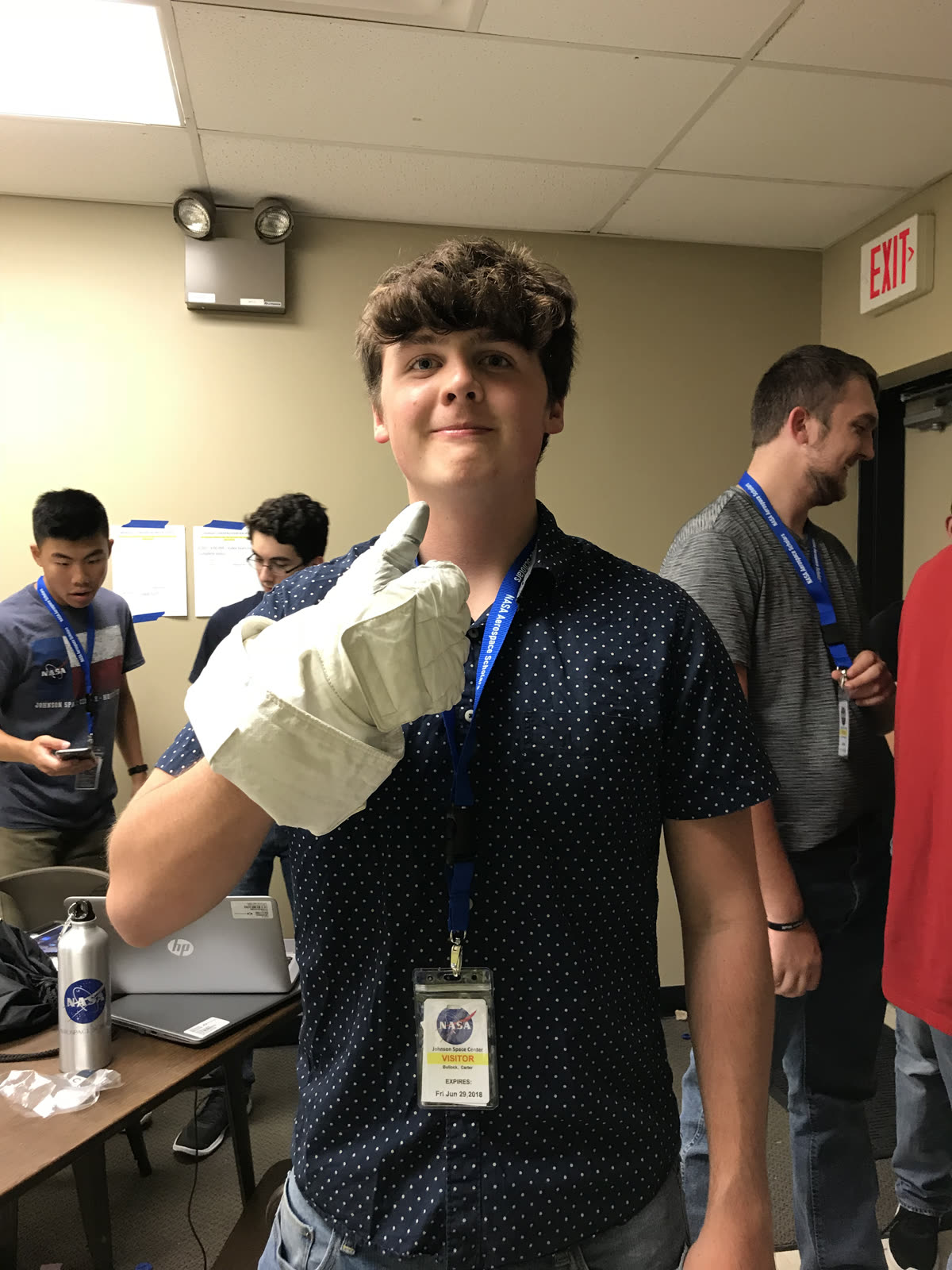
Carter Bullock with Apollo astronaut glove at NASA

I've been drawn to engineering for as long as I can remember. Growing up in Texas, I was captivated by space exploration — the idea that humans could build machines capable of traversing the surface of Mars or the Moon felt like the most exciting problem in the world. That fascination never left me, and it shaped every decision I made on the way to where I am today.

Chasing that passion led me to pack up and move from Texas to Massachusetts to pursue a degree in Robotics Engineering at WPI — a commitment I made without hesitation, because building intelligent machines isn't just a career path for me, it's what I'd be doing anyway. Outside of work I'm always tinkering on side projects, whether that's prototyping hardware, writing software for fun, or finding a new problem worth solving.

That's the part of engineering I love most — the moment a problem lands in front of you and you get to figure it out. The tools change, the domain changes, but that feeling never does.

Background

I'm a Software Engineer III and Team Lead at Autonodyne, where I design and ship production software for autonomous platforms. Promoted to team lead within my first year, I own project roadmaps, lead cross-functional engineering teams, and translate technical work directly into business impact.

My background spans the full autonomous systems stack — from C++ messaging infrastructure and MAVLink protocols to LiDAR sensor fusion pipelines and computer vision navigation. I hold a B.S. in Robotics Engineering with a Minor in Computer Science from Worcester Polytechnic Institute, where I competed in NASA's Robotics Mining Competition as part of my senior capstone.

I thrive at the intersection of hardware and software, turning complex systems requirements into reliable, well-architected code.

  Senior Thesis
Skills

Languages
C++ C C# Python Java JavaScript Bash
Robotics & Systems
ROS Gazebo MAVLink OpenCV SLAM Arduino Verilog
Networking & Comms
UDP TCP WebSocket Wireshark UWB
Tools & Platforms
CMake Docker Git / GitLab MATLAB SolidWorks Linux / Unix Unity ANTLR
Practices
Agile / Scrum Peer Code Review Code Architecture Design Cross-Team Collaboration Pair Programming

Experience

Software Engineer III & Team Lead
Autonodyne
  June 2023 – Present  ·  Boston, MA
  • Promoted to team lead within one year, taking ownership of project roadmaps and leading cross-functional engineering teams to deliver production software on time.
  • Prototyped a new platform capability that was pitched to and won the largest contract in company history, demonstrating ability to rapidly learn new systems and translate technical work into business impact.
  • Designed C++ messaging services and communication sequences enabling operator-facing applications to interface with autonomous platform messaging buses, building deep familiarity with autonomous system telemetry, state output, and navigation data.
  • Established engineering best practices across the team through Agile ceremonies, peer code reviews, and code architecture design discussions with program managers and stakeholders.
Software Engineering Intern
Third Insight A.I.
  May 2022 – Aug 2022
  • Architected a fully abstractable communication module handling all message passing between a ground control station and an autonomous drone over TCP/UDP.
  • Implemented multi-threaded synchronous and asynchronous MAVLink message transmission with robust protocol handling including queuing, blocking, forwarding, and interception.
  • Designed a functional API enabling seamless integration with all MAVLink protocols, reducing integration overhead for future autonomous platform development.
Robotics Engineering Intern
Third Insight A.I.
  May 2021 – Aug 2021
  • Developed sensor fusion pipeline integrating LiDAR point cloud data into a voxel-based computer vision system for drone and rover autopilot state estimation.
  • Produced real-time position estimation via UWB triangulation; performed infrared and thermal sensor calibration and parsed point cloud data for downstream navigation.

Education

B.S. Robotics Engineering, Minor in Computer Science
Worcester Polytechnic Institute (WPI)
GPA: 3.5 / 4.0
Graduated May 2023
Dean's List

Programs

NASA Texas Aerospace Scholars
NASA Johnson Space Center — Houston, TX

A highly selective, multi-phase STEM program run by NASA's Johnson Space Center for Texas high school students. The program begins with months of rigorous online coursework covering aerospace engineering, orbital mechanics, and mission design — only top performers advance to an all-expenses-paid residential week at JSC. There, teams tackle authentic mission engineering challenges, tour active NASA facilities, and work directly alongside NASA scientists and engineers. Selection to the on-site phase is competitive among thousands of state-wide applicants, making it one of the most prestigious pre-college aerospace programs in the country.

2018
On-Site Participant
FIRST Robotics Competition — Co-Founder
Wimberley High School, Wimberley, TX

Co-founded Wimberley High School's inaugural FIRST Robotics Competition team, building the program from the ground up — recruiting students, securing mentors, and raising the funding needed to compete. FRC challenges teams to design, build, and program industrial-sized robots in a six-week build season, then compete in a fast-paced game that demands mechanical design, software, and strategy working in concert. In our rookie season the team earned the Texas All-State Rookie of the Year Award, given to the first-year team that best exemplifies the FIRST mission, Gracious Professionalism, and impact within their community — a distinction that requires judges to see exceptional promise across engineering, outreach, and team culture simultaneously.

2018 – 2019
Co-Founder
Texas All-State Rookie of the Year

Projects

NASA Lunabotics Robot
NASA Lunabotics MQP
WPI Senior Capstone
Aug 2022 – May 2023
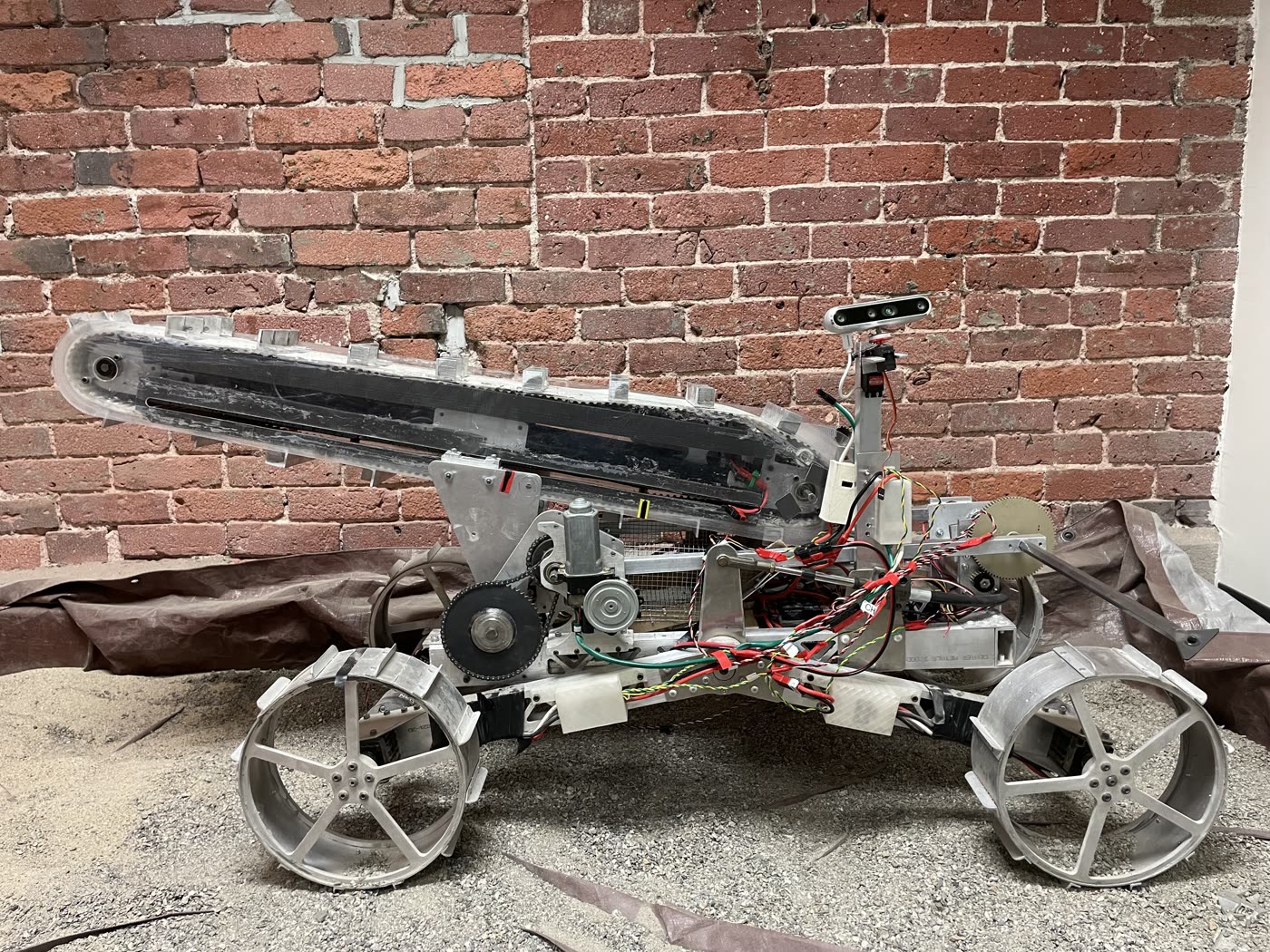
Competed in NASA's Robotics Mining Competition. Led sensor integration and autonomy development including hall effect and pressure sensor feedback loops, encoder-based autonomous drive and actuation control, and computer vision navigation using AprilTag localization, stereo depth obstacle avoidance, and A* path planning on a real-world robotic platform.
ROS OpenCV A* Path Planning AprilTag C++ Python Arduino
Development Footage

Prototype excavation mechanism design and bucket assembly testing

Encoder-based closed-loop wheel drive validation for autonomous navigation

Hall effect sensor integration for linear slider limit detection

Excavator belt system extracting material into a collection bucket for deposit later

Full range-of-motion testing of the excavation arm actuation system

Tuning the material offloading and deposit sequence into the collection bin

* All footage shown is from development and testing phases. Video from the NASA competition is not available.

Robotic Arm Actuation
WPI
Jan – Mar 2022
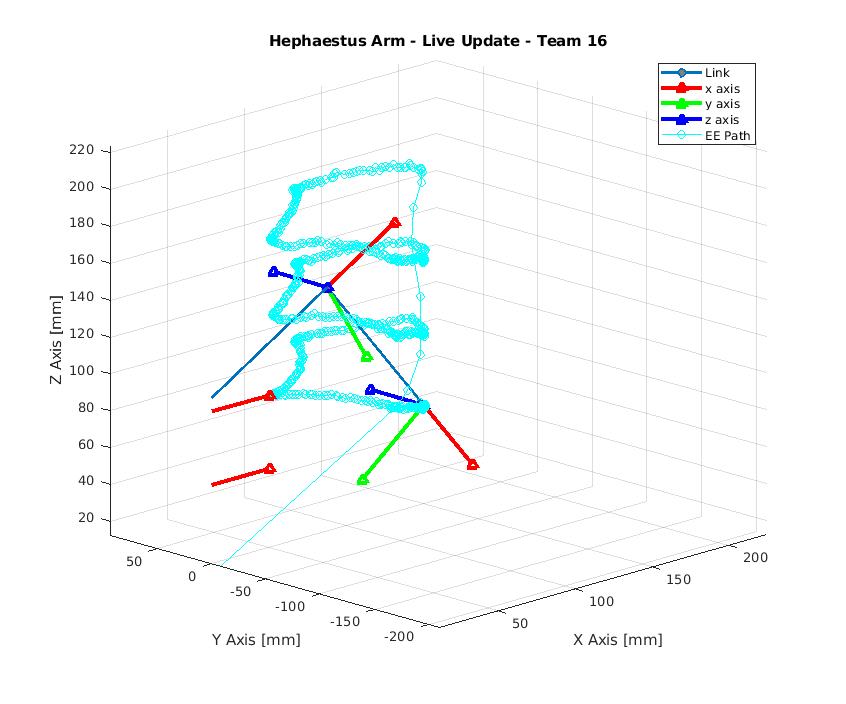
Programmed a three-link robotic arm to reach any 3D position using inverse dynamics for real-time joint angle, velocity, and acceleration computation. Integrated computer vision for autonomous object sorting.
Inverse Dynamics Computer Vision MATLAB C
Development Images
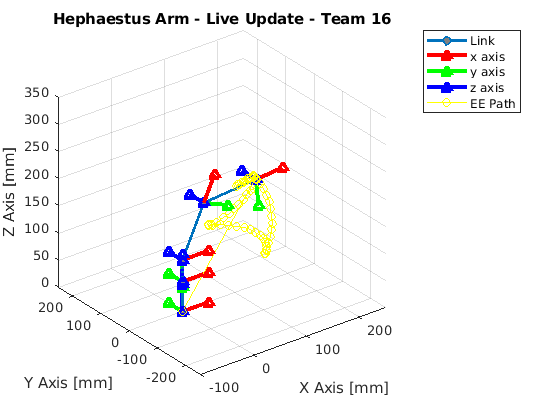
Arm motion tracking

End-effector motion path tracking through 3D space

Arm movement potential

Reachable workspace visualization showing positional coverage

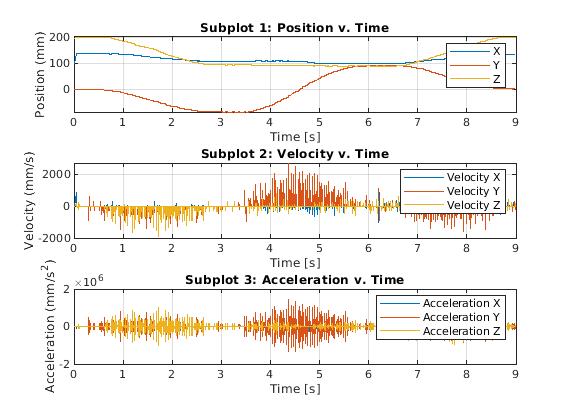
Velocity and acceleration graph

Joint velocity and acceleration profiles from inverse dynamics computation

Sensor Fusion & Robot Control
WPI
Oct – Dec 2020
A series of robotics projects exploring multi-sensor integration and closed-loop control. Built systems leveraging IMU, sonar, LiDAR, and light sensors across three distinct platforms — a balancing robot with collision avoidance, a maze-exploring TurtleBot, and a line-following rover — each implementing different control strategies including PID control, A* path planning, and sensor fusion.
IMU / Accelerometer 360° LiDAR Sonar PID Control A* Path Planning ROS Sensor Fusion C++
Project Demonstrations

Motor-driven robot using Kalman-filtered IMU data for position smoothing and collision detection, with a sonar sensor running PID control to follow along a wall

TurtleBot using 360° LiDAR point arrays to run A* path planning and mapping algorithms for full maze exploration with obstacle avoidance

Robot using a light sensor and PID control to follow a line of tape across the ground

Computer Vision Drone Tracker
Personal Project
2025
Developed a learning-free, single-script computer vision system for tracking fast-moving objects — including drones — across video frames without any training data or ML model weights. Detection uses YOLOv8 for first-frame initialization followed by a novel dual template matching pipeline combining pixel similarity (60%) and Canny edge response (40%), driven by a Fermat spiral search pattern with Fibonacci-scaled radii. Camera motion is compensated in real time via optical flow on background features, and multi-resolution evaluation on the outer spiral provides a ~4× speedup. Output confidence is color-coded: green for confirmed lock, yellow for soft estimate, and red for lost target.
Python OpenCV YOLOv8 Template Matching Optical Flow Object Detection Computer Vision
Tracking Demonstration
Raw Footage
Tracked Output

Side-by-side comparison of raw drone footage and the Fermat spiral tracker output, color-coded by detection confidence.

Q-Learning Bomberman AI Agent
WPI — RBE 470x: AI for Robotics
2023
Developed a Q-learning agent with linear function approximation for a Bomberman-style environment, engineering hand-crafted state features and implementing temporal difference weight updates to train an autonomous agent capable of navigating to the exit while avoiding monsters and bomb explosions.
Q-Learning Reinforcement Learning Python Pygame

Get In Touch

I'm always open to interesting opportunities, collaborations, and conversations about autonomous systems and robotics.

carterbullock00@gmail.com LinkedIn GitHub